1月に,オークランド大学で行われる,Working with Wordsという講座に申し込んだ。
そこで,前もって読んだらよい推薦書が書かれてあったので,早速読破した。
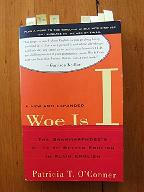
著者はThe New York Times Book Review元編集者。
英文ライティングのための本である。
文法書ではない。
非常にコミカルに書かれているので,おもしろい。
以下の抜粋にピンと来た人は是非読んだらいいと思う。
Keeping Up with the Joneses: How Names Multiplyより
In my daughter’s preschool class, there two Larries [ouch!], three Jennifer’s [oof!], and two Sanchez’ [yipes!]. It’s Larrys, Jennifers, and Sanchezes.
Suggestive Languageより
Use be instead of was or were after someone suggests, demands, asks, requests, requires, or insists that something be done:
I demanded that I be excused. . . .
If be sounds unnatural to your ear, just imagine an unspoken should in front of it:
I demanded that I (should) be excused. . . .
By the way, the form of the verb used here - be instead of was or were - is similar to the one used for a command: Be good! Be quiet! Be there or be square!
Infinitively Speaking (コラム)より
Are you anxious to go, or are you anxious about going? If you picked anxious to go, you should be anxious about your grammar.
That’s Thatより
When a time element comes after the verb: Junior said on Friday he would pay up. This could mean either: Junior said that on Friday he would pay up, or Junior said on Friday that he would pay up. So why not add a that and make yourself clear?
The Incredible Shrinking Words: Contractions / Out Of Boundsより
ain’t. It’s not OK and it never will be OK. Get used to it. If you’re tempted to use it to show that you have the common touch, make clear that you know better: Now, ain’t that a shame!
Mixed Doublesより
beside / besides. Pip was seated beside Miss Havisham is an uncomfortable chair. He had a fly in his soup besides.
You’re Getting Warmer: Spelling and Saying It Rightより
advertise / advertisement / advertising. Here in the United States, each of these has an s (the preference in Britain is to use a z). When Jack got his job at the advertising agency, he didn't advertise the fact that he's never written an advertisement.
The Living End: The Period (.)より
If a sentence ends in an ellipsis (three dots that indicate an omission), put a period first to show that the sentence is over: “You’d like to borrow fifty dollars?” said Apu. He recalled the old saying, Neither a borrower nor a lender be. . . .
補足:最後のbeのあとのドット4つは,1つめがピリオド。→beとピリの間にスペースなし。そのあと省略符(ドット3つ)おく。
この文ではrecalled an old saying「古い言い習わしを思い起こした」がポイント。
Neither a borrower nor a lender be. というのは有名なハムレットのセリフである。
よって,「引用」なのでこのセンテンスにはピリオドが必要,続く省略符(ドット3つ)はその後の文章の省略という意味である。
But if you want to emphasize a deliberate trailing off, you may omit the period. End the sentence with a space, then the three dots:
“Well . . .”
補足:Wellと省略符の1つ目のドットとの間にはスペースあり。
Huh? The Question Mark (?)より
. . . Or for emphasis, you can put a question mark after each item (you don’t need capital letters for each item, since it’s still one sentence):
Would Tina have to buy a new hair dryer? toothbrush? swimsuit?
Betwixt and Between: The Hyphen (-)より
If it’s after the noun, don’t use a hyphen:
This chicken is well done.
If it’s before the noun, use a hyphen when either of the two words in the description wouldn’t make sense by itself.
This is well-done chicken.
Enough said: Quotation Marks (“ ”) / Sometimes In, Sometimes Outより
Question mark. In most case, a question mark should be inside the quotation marks: “Who goes there?” said the sentry. But the question mark must be outside if it’s not part of the actual quotation: Who starred in “Dynasty”?
Apostrophe. . . . for example, the title of a poem, “The Raven” - you would have to put the apostrophe outside: “The Raven”’s first stanza is the best. Pretty awful-looking, isn’t it? It’s so awful that many publications even cheat to avoid it, and write “The Raven’s” - definitely incorrect, although much prettier. My advice is to avoid this problem entirely. Instead of writing “The Raven”’s author was Poe, rearrange it: Poe was the author of “The Raven.”
(以上,Patricia T. O'conner著 「Woe Is I」より抜粋)